Instructor Ed Jones has over 30 years of experience in theindustry, has the title of MasterWater Restorer, is an Institute ofInspection Cleaning andRestoration Certification (IICRC)-approved instructor, and hasserved on the S500-2021consensus body committee todevelop the most recent standard.
The ANSI/IICRC S500-2021 Standard states, “Category 1 water can deteriorate to Category 2 or 3. Once microorganisms become wet from the water intrusion, depending upon the length of time that they remain wet and the temperature, they can begin to grow in numbers and can change the category of the water." The issue is how long should you wait before changing category 1 to category 2 and how long it takes to go from category 2 to category 3? There is no time given in the S500 on how long it takes to deteriorate each category.
The answer is not easy because it is a critical thinking exercise that must consider many different variables. In most cases this is a subjective determination that must rely on evidence at the loss location. See some of the factors below that I recommend be considered before deteriorating category of water:
Say you have a supply line break that flows through the structure going from room to room and possibly under walls, cabinets, and floors. To be clear, to go from category 1, which is defined as "does not pose substantial risk" to category 2, defined as "significant contamination and has the potential to cause discomfort or sickness" is a pretty big jump! Remember, category 1 water does NOT have to be sanitary, the definition states it originates from a "sanitary source" like a supply line, but once it leaves the source it no longer sanitary and it can still be category 1 as long as there isn't a "significant" health risk evident. I tell my students the word "significant" is significant and category 2 should represent a significant health risk, NOT just water that ran through a normal wall or a ceiling.
You must also consider the conditions of the structure, including age of the building and potential previous moisture or cleanliness issues. If category 1 water runs into pet urine saturated carpet it goes immediately to category 2. But if the water runs through a wall, it does NOT necessarily change to category 2 unless there is a significant microorganism risk. I've heard instructors say that "building soils" can cause category 1 to go to category 2, but there is nowhere in the S500-2021 standard that it states that. Soil is not inherently dirty! In our testing of a normal home the bacteria levels don't rise high enough to be considered a "significant" health risk. Even one mouse dropping inside the wall cavity won't be enough to change the category of water depending on the rate of dilution of category 1 water. Again, I've heard from technicians that if there is any "speck" of fecal matter at all, then it automatically goes to category 3, which is defined as "grossly unsanitary." I dispute that, based on a case-by-case basis for in most cases where we have tested the water it doesn't reach a grossly unsanitary condition that would reflect pathogenic or toxigenic conditions. *See Getting EDucated Article on What is ATP Testing?
Odors can be an indicator of hidden water damage and that microorganisms are growing, so you might have to perform what I call Selective Invasive Investigation or opening up an area in the least invasive manner possible to see what is going on inside the wall or ceiling cavity or underneath the cabinet or vanity. *See Getting EDucated Article on Selective Invasive Investigation
We can predict how long the materials have been wet from dark water stains, deterioration of materials, and visible mold. I tell my students to go to where it was the wettest, the longest on the material most likely to grow mold and open up a small area to see if we have potential microbial growth. When you are thinking of deteriorating the category of water this could be a clue to the length of time the materials have been wet. I tell them if they find significant microbial growth then it might be time to go to category 3 due to time, especially if the visible mold is over 10 SF. Take photos of how much potential microbial growth there is, what's it growing on, and confirm that we think the mold came from this water loss and was not pre-existing. Then we can talk to materially interested parties about changing the category of water based on available evidence. Remember, take photos of the wet materials and any signs of long-term damage during each step of your investigation to show what you found.
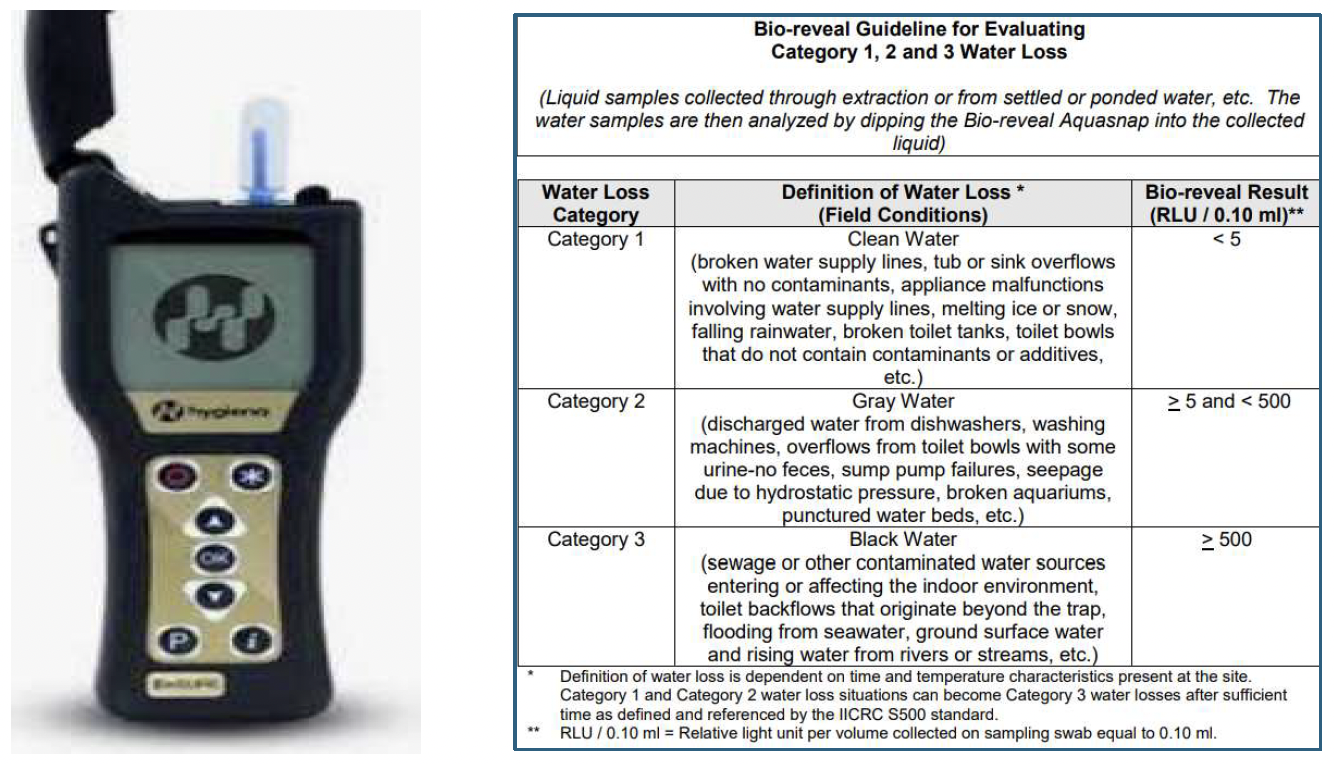
When there is a dispute between materially interested parties, then testing by an Indoor Environmental Professional (IEP) may be necessary or you may want to try testing with an ATP meter. Remember, if using an ATP meter to test for bacteria and fungi I recommend you agree on a sampling strategy before any testing is performed because that will be critical to getting both parties to agree on the results. I recommend you read Dr. Ralph Moon's article on ATP Testing: Use & Misuse in the Restoration Industry, https://ralphemoonphd.com/Publications/ATP%20Paper%20JoCS%20March21.pdf, for this technology has been tested at our IICRC approved ASD Flood House to be a good resource for judging bacteria and fungus levels, but as with all technology it can be misused to try to inflate invoices by a few unscrupulous contractors.
So, in summary, look for clues on how long materials have been in contact with the water (dark staining, deterioration of materials, visible mold, etc.) by going to where it was the wettest, the longest on the materials most likely to represent an organic food source for mold (baseboards, drywall paper, wood sill plate, etc.). Take good photos of each step of your investigation and be prepared to explain your reasoning on why you deteriorated the category of water from 1, 2 to 3. *See Getting EDucated Article on 7 Factors to Consider When Determining Category of Water
Contractor Newsletter
Sign up today to receive quarterly tips on best practices in home repair, growing your contracting business, and more.