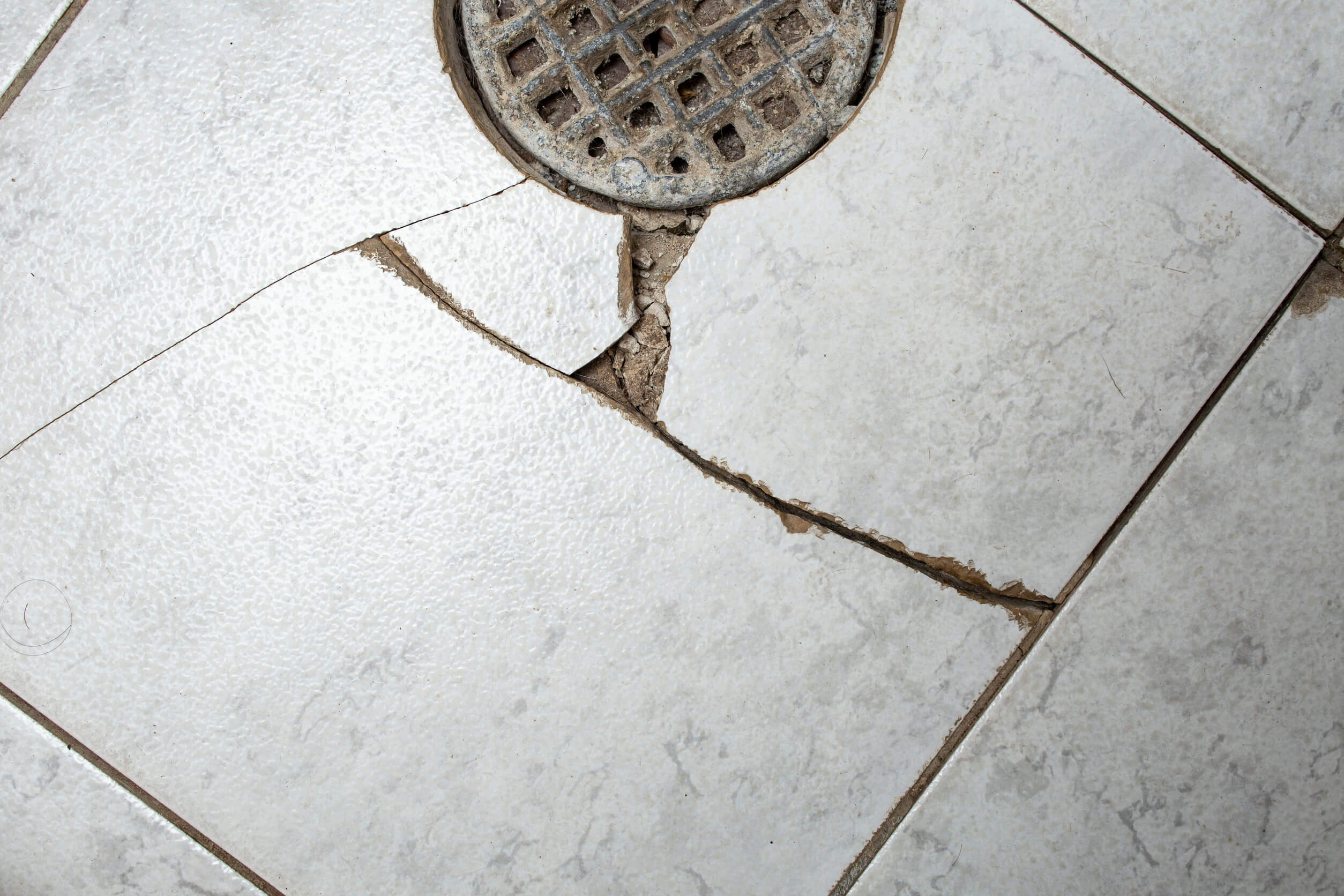
First, it does not hurt ceramic tile or grout to get wet. That is why we use ceramic tile in wet spaces, such as showers and tub surrounds, in the first place.
Because of that, it is generally not necessary to dry ceramic tile, grout, cement board, or concrete that may be underneath it.
Common Causes of Cracked or Broken Tile
The most common reasons for cracked or broken tile are:
- Ground movement, also called reflective cracks
- Installation issues
As we track the number of cracked tile and grout issues, we have seen far more issues in Southern California than in any other state.
Why is that?
That is where we often see more ground movement and foundation settling due to underground tectonic movement and fault lines.
Installation Issues Can Also Cause Tile Failure
There are guidelines for ceramic tile installation that are dictated by the ANSI A108 series and the Tile Council of North America, also known as TCNA, Handbook.
These standards require specific:
- Substrate preparation
- Bonding
- Crack-isolation procedures
These steps help ensure structural integrity and help prevent failure.
Too many times, the tile installer does not properly prepare the substrate. Other times, the adhesive is allowed to “skin” over before the tile is installed, the tiles are only spot-bonded, or the adhesive is not allowed to cure long enough before grout is installed or before people walk on the tile.
These installation issues can eventually cause tile to debond or crack.
What to Identify When You Find Cracked Tile or Grout
When you find cracked tile or grout, it is important to slow down, ask questions, and document the condition clearly.
Below are several key questions to consider.
1. Was the Cracked Tile or Grout Pre-Existing?
Determine whether the cracked tile or grout was a pre-existing issue.
Provide time-stamped and GPS-stamped photos of any pre-existing conditions.
Broken or loose tiles may still need to be removed so the substrate can be dried. However, it should be discussed ahead of time that the damage may be a pre-existing issue and may not be covered by homeowner’s insurance.
Consult the insurance adjuster, and do not give insurance advice.
2. Was the Tile Damaged During Demolition?
Determine whether the cracked tile or grout was caused by a contractor performing demolition of materials next to the tile.
Examples may include removing:
- Base cabinets
- Baseboards
- Transition strips
- Other nearby materials
Look for chips or broken tiles along the edges where the material was removed.
The contractor could be responsible for the cracked or chipped tile if the potential for chipping or cracking was not discussed before the material was removed.
3. Was the Tile Grouted Tightly Against Another Material?
Another situation may involve tile that is grouted tightly against an MDF baseboard or particleboard base cabinet.
If that baseboard or cabinet needs to be removed due to loss of structural integrity, such as swelling from water exposure, it may be very difficult to remove it without chipping or cracking the tile.
This should be discussed ahead of time.
A disclaimer may need to be obtained before removing the wet material and potentially cracking or chipping the tile.
4. Could Water Have Caused the Tile or Grout to Loosen?
There are always exceptions.
In the case of cracked tile or grout, there may be situations where water caused the tile or grout to loosen or crack.
This is typically associated with slow leaks in a concrete foundation that saturated the adhesive under the tile for an extended period of time. Over time, that can cause the tile to loosen, which may allow it to crack or separate from the substrate.
Document Before Proceeding
When cracked, chipped, or broken tiles are found, take both overview and close-up photos to clearly show the issues.
Your documentation should help answer:
- Where is the damage located?
- Is it pre-existing?
- Is it near areas where demolition occurred?
- Is there evidence of poor installation?
- Is there a possible slab leak or long-term moisture issue?
- Does the tile need to be removed to dry the substrate?
Call “Time Out” Before Moving Forward
Cracked or broken ceramic tile is a critical thinking exercise.
Before proceeding, ask the right questions, gather evidence, take clear photos, and call “Time Out” to discuss options with materially interested parties.
This helps avoid confusion, protects the customer, and helps restorers make a better professional recommendation.
Final Thoughts
Cracked, chipped, or broken ceramic tile should not be automatically blamed on the water loss or the drying process.
Common causes include ground movement, installation issues, pre-existing conditions, demolition damage, or long-term moisture problems such as slab leaks.
The best approach is to document carefully, communicate clearly, and discuss the situation before moving forward.