Instructor Ed Jones has over 30 years of experience in theindustry, has the title of MasterWater Restorer, is an Institute ofInspection Cleaning andRestoration Certification (IICRC)-approved instructor, and hasserved on the S500-2021consensus body committee todevelop the most recent standard.
The water damage restoration industry has experienced an epidemic of unnecessary demolition for many years that has dramatically driven up homeowners’ insurance premiums. Back-in-the-day (when I owned a restoration business over 25 years ago) we all cut out wet drywall, typically 2 feet up the wall, and removed all wet carpet padding. Then we would “float” the carpet so all the dust we created cutting out the drywall would be spread throughout the home! In the 2000’s we started drying more materials in-place once the Applied Structural Drying courses were developed and ASD flood houses gave restorers a chance to try to learn how to dry as many materials in-place as possible. Unfortunately, with the advent of more water loss claims handled by vendor programs and the emphasis on driving the work to one-stop shops, urgency to close files quickly, and managing the claim by a mobile app software vs. industry knowledge and critical thinking, we’ve gone backward, and we are now seeing much more demolition than we did when the ASD flood houses first came into existence. Do you realize just last year, we threw away more than 40 tons of drywall into landfills in this industry alone and much of that didn’t need to happen!
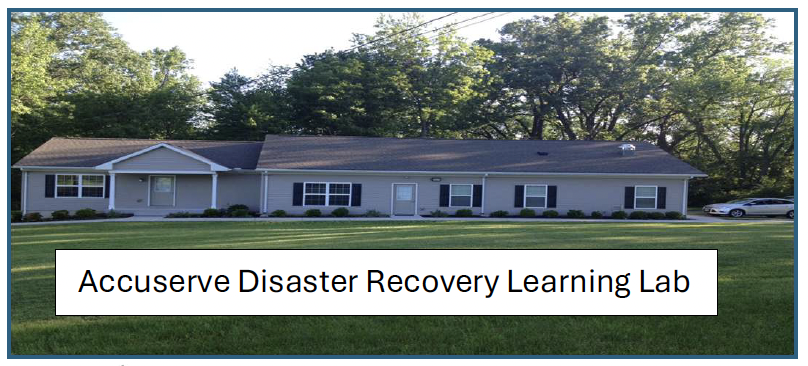
Each one of my IICRC approved ASD classes held at our Disaster Recovery Learning Lab or DRLL built on the Clark State college campus in Springfield, OH, we show the students a normal home built according to local building codes flooded with over 1500 gallons of water, including standing water on a concrete slab portion of the home with berber carpet installed over rebond cushion. I make sure to run the water hose for hours next to one of the exterior walls so when the students take their initial tour of our flood house, they see standing water up on top of saturated carpet against an exterior wall with 1/2" drywall with fiberglass insulation in the wall cavity and stained pinewood baseboards. We let the house sit wet for 24-36 hours before the students arrive to exacerbate the conditions as much as possible. Then we proceed over the next few days during the ASD class to dry out all the materials with NO DEMOLITION! In full transparency we do show removing one baseboard to drill holes in an exterior wall in one room due to there is vinyl wallpaper on that wall, which is a vapor barrier, and we show how to introduce air into the wall assembly to dry behind vapor barriers with the least amount of demolition. Also, we remove the toe kick from the kitchen base cabinet to dry underneath. We reinstall both after the house is dry.
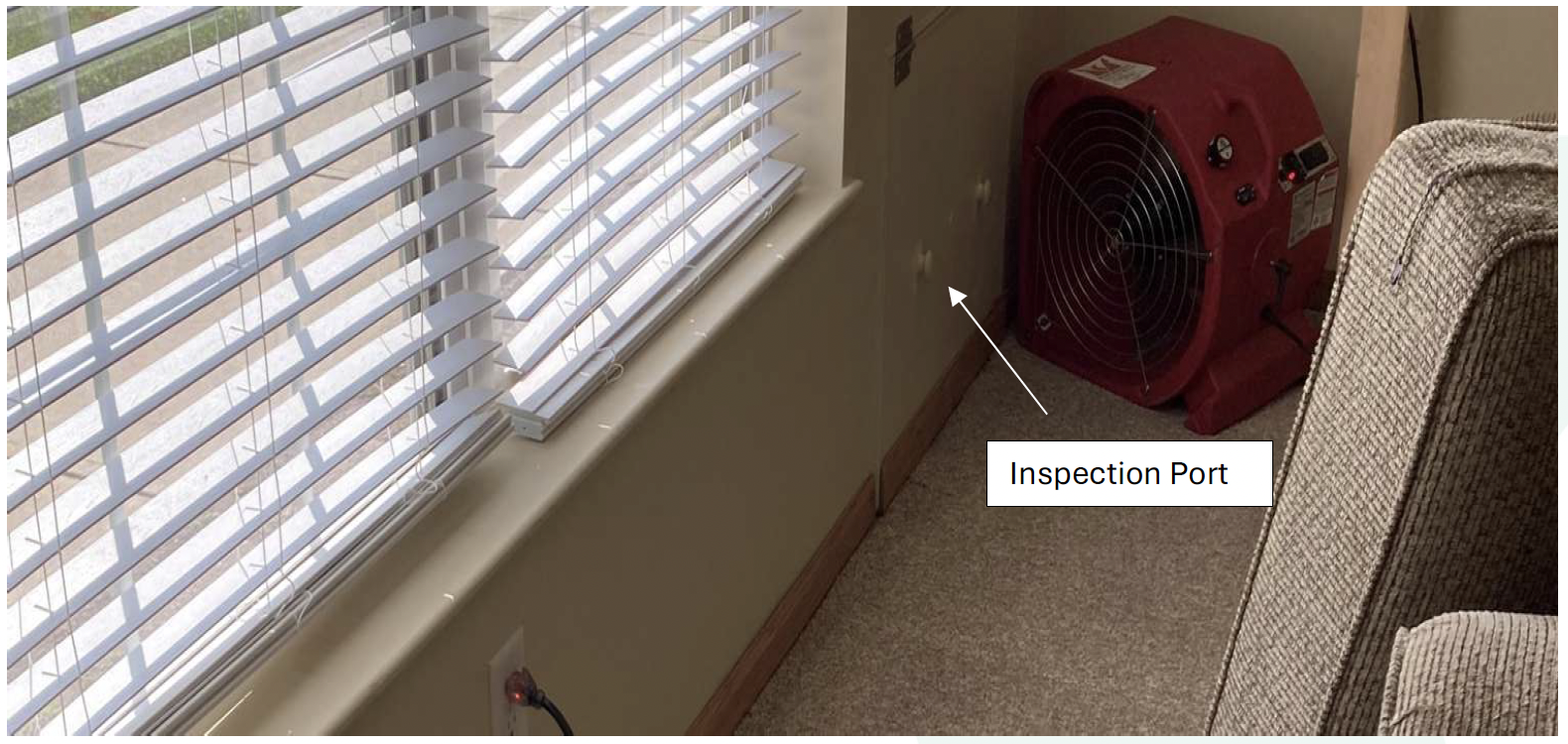
We built access panels into exterior walls so the students can open up the wall to prove to them the insulation didn't get wet enough to remove it and that there is no mold in the wall cavities and behind baseboards, even after 140 floodings!
I explain to the students that when water migrates through a structure and touches the bottom of a wall the water wicks up into the drywall through capillary action but doesn't get the insulation significantly wet in the process. Also, we don't have to pull baseboards and drill holes or perform 2' flood cuts to dry inside the walls if there is no vapor barrier! I tell them we didn't open up the wall to get the water in there and we don't have to open up the wall to get it out! As long as they use the "science of drying" which we teach during the ASD class, they learn how to dry without so much demolition and mess. Basically, we teach them about vapor pressure differentials and how to provide the right conditions for drying, so the water inside the walls and under the carpet and pad quickly dry without removing materials and opening up walls and blowing air under carpeting. In EVERY class we have the carpet dry in 12 hours, carpet cushion (pad) dry in 36 hours, and drywall and baseboards dry in 3-4 days with NO removal of materials and without opening walls or lifting carpet and removing pad! We don’t put any airflow under the carpeting but do place air movers and dehumidifiers per industry standard formulas and recommendations. Important to take readings DAILY and make adjustments to our drying plan.
I provide my students with my Key Performance Indicators (KPI’s) for validating drying progress in a residential setting that includes expectations on category 1 water losses to have the carpet dry in 24 hours, carpet cushion (pad) dry in 48 hours, and subfloors and sill plates dry in 3-4 days. We also demonstrate how to dry engineered wood flooring (plywood core, not HDF) and hardwood flooring typically in 5-7 days, depending on the situation. Just for clarity in the ANSI/IICRC S500-2021 Standard Appendix A states that carpet and drywall are generally restorable when affected with categories 1 or 2 water. Then why do we see so much demolition of carpet, carpet pad, and drywall? I think the there are several answers, including not enough proper training, not holding restorers accountable, and because it is so much easier to hire a technician and teach them to tear out materials than to get them certified and learn how to dry materials in-place. Yes, liability can come into play, but if you know how to properly take psychrometric and moisture content readings, record them on your moisture logs, and provide a detailed sketch/moisture map along with labelled photos showing final readings and locations of those readings you can build a very defensible drying project file that can be provided to all materially interested parties.