Instructor Ed Jones has over 30 years of experience in theindustry, has the title of MasterWater Restorer, is an Institute ofInspection Cleaning andRestoration Certification (IICRC)-approved instructor, and hasserved on the S500-2021consensus body committee todevelop the most recent standard.
Besides training IICRC approved WRT & ASD courses and assisting on water/mold related issue files, I sometimes serve as an expert witness when there are allegations of incomplete or improper drying. Typically, whether I'm defending the restorer or helping prosecute them it comes down to how well did they document the drying process?
When you examine the ANSI/IICRC $500-2021 Standard for Professional Water Damage Restoration it is very clear on what documentation is required on EVERY water loss drying project:
• structure type and use; • source, date, and time of water intrusion; • status of water source control; • general size of affected areas (e.g., number of rooms, floors); • suspect or known contaminants; • history of building usage; • history of previous water damage; types of materials affected (e.g., flooring, walls, framing); • age of structure; • changes in structure design; and • number of occupants.
In addition to that information the S500 "requires" the following information be provided:
"Restorers should maintain organized logs to monitor progress and demonstrate the effectiveness of the drying process."
• the name of the project; • the dates and times of service; the person performing the service; • the instrumentation used; • the appropriate psychrometric readings (e.g., temperature, RH) in affected areas, unaffected areas and inlets/outlets of dehumidifiers or HVAC systems, if present; • moisture level or content measurements of representative materials in the affected and unaffected areas; • drying goals and standards for the affected materials; and • location of the moisture level or content readings.
The required documentation listed also includes:
• documentation reflecting client approval for the use of antimicrobial (biocides) including consumer "Right to Know" information; and • records of pressure readings in and out of containment erected for the purpose of remediation.
Invariably, when I'm reviewing drying logs the weakest area is always the moisture content readings with the psychrometric readings running a close second.
Your DAILY readings, psychrometric & moisture content, MUST show that all the materials that you were drying have been returned to acceptable moisture levels that would inhibit the growth of mold and support your length of drying time.
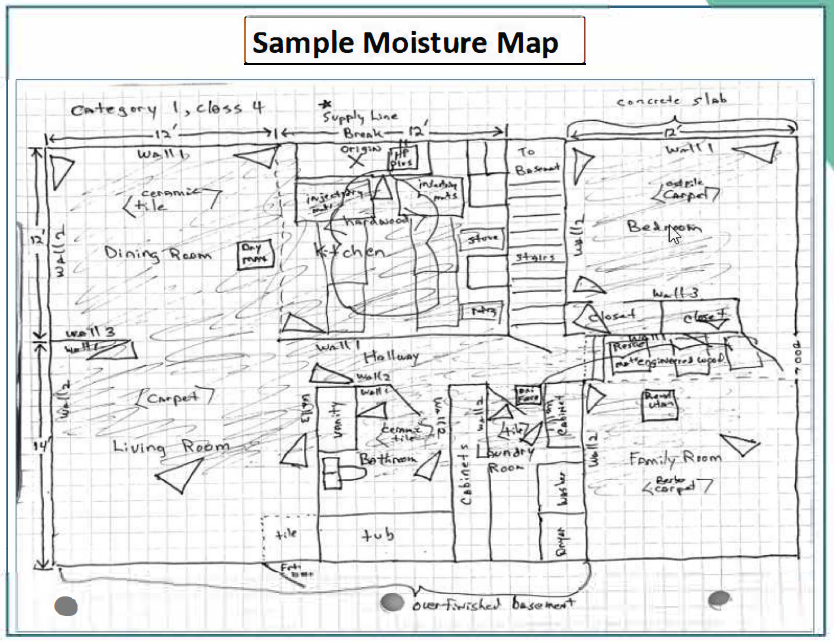
In residential drying projects it is best to have a sketch/drawing of the affected areas with moisture points labeled (e.g., Living Room/Wall 1/Sill Plate/15%/Day 4 or Dining Room/Wall 2/Drywall/8%/Day 3). Wet floors and ceilings can be identified as quadrant A, B, C, D, etc. with each quadrant of floor separated by 50-70 SF and ceiling quadrants by 100-150 SF, as is used in the air mover formula. *See sample Moisture Map next column
Your sketch doesn't have to be fancy and I've yet to see a good sketching tool in current mobile apps that clearly lets you label moisture points on walls, floors & ceilings, yet this is so critical! Just make a drawing and take a photo of it with the mobile app your using and label it, Moisture Map. I recommend showing initial equipment setups, as well.
Be sure to provide photos of your final readings to go along with your moisture content records and your Moisture Map, including photos of initial moisture content readings & equipment setup in each affected room/drying chambers with containment separating affected from unaffected areas.
Include wet surface temperature readings on class 4 situations when there is extended drying to help validate length of drying time.
Finally, take time to let your thermo-hygrometer acclimate when taking psychrometric readings for many times I see psychrometric readings that just don't make sense, so either someone is making up the readings or not allowing their thermo-hygrometer to acclimate fully. It is possible to tell when someone is making up the readings!
A little extra time taken to create detailed documentation on a drying project could save or cost you thousands and thousands of dollars! I've seen it happen! Be GREAT at taking your readings and telling your "drying story" with photos, readings, and a good Moisture Map.
Contractor Newsletter
Sign up today to receive quarterly tips on best practices in home repair, growing your contracting business, and more.