Instructor Ed Jones has over 30 years of experience in theindustry, has the title of MasterWater Restorer, is an Institute ofInspection Cleaning andRestoration Certification (IICRC)-approved instructor, and hasserved on the S500-2021consensus body committee todevelop the most recent standard.
The confusion in today’s water mitigation industry around when should medium vs. large refrigerant dehumidifiers be selected stems around how pricing software systems pay for refrigerant dehumidifiers by Medium (less than 70 pints per day pints or ppd), Large (70-109 ppd), XLarge (110-159 ppd), and XXLarge (160 ppd and greater). The S500-2021standard only gives direction (in Appendix B, so not actually in the standard itself) for using a simple or detailed formula for initial refrigerant dehumidifier placement amount rated at ppd as rated by the Association of Home Appliances (AHAM). The S500-2021 Appendix B only recommends a minimum level of dehumidification to achieve humidity control to prevent secondary damage and the restorer should use their psychrometric readings to judge how best to reach the drying targets established in their drying plan.
The simple refrigerant dehumidifier formula, which is used most of the time in residential settings, recommends so many ppd of dehumidification based on the cubic feet of air in the drying chamber, the class of water, and the type of dehumidifier, conventional, low grain refrigerant (LGR), or desiccant.
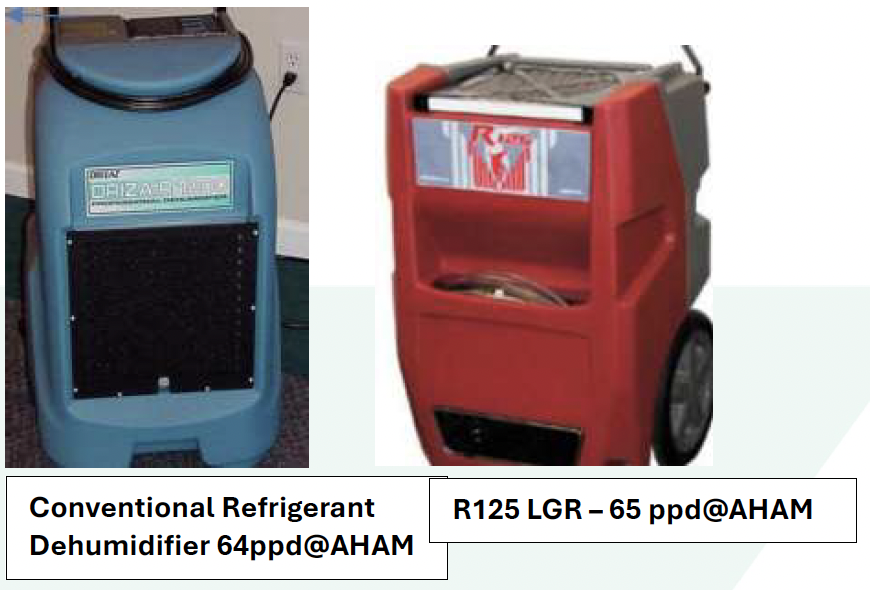
The confusion is there is only one LGR dehumidifier rated below 70 ppd@AHAM, the Phoenix R125 rated at 65 ppd, and most restorers only have conventional dehumidifiers rated under 70 ppd that would be considered medium. Most vendor programs have learned in their training that conventional dehumidifiers can’t lower the humidity ratio in the drying chamber, low enough to dry effectively, so conventional refrigerant dehumidifiers are discouraged. This puts the restorer in a dilemma because most restorers aren’t aware of the R125 LGR and only have conventional refrigerant dehumidifiers that are rated below 70 ppd.
When asked by restorers what they should do I tell them to place a large LGR dehumidifier, if that is what they have, but only charge for the medium because it doesn’t hurt to have more dehumidification than required, especially if the outside conditions are unfavorable for drying. I explain further that vendor programs can’t control what dehumidifiers the restorers on their programs purchase, so they simply pay by the pricing software guide for how many ppd are required per the simple dehumidifier formula.
It is up to the restorer to utilize a balanced drying plan to dry as quickly and efficiently as possible. My opinion on conventional refrigerant dehumidifiers is that they should no longer be sold, but because many adjusters and programs don’t understand the difference between conventional and low grain refrigerant dehumidifiers, they go ahead and pay for them, thus the reason they are still sold in today’s marketplace.
You wouldn’t buy an outdated computer for your business that utilizes 1980’s technology, would you? I’m not saying that conventional refrigerant dehumidifiers don’t work at all because they do assist with lowering humidity levels when it is warm and humid (over 60 gpp) but stop working below 55-60 gpp. In today’s high technology drying world where we need to dry as many materials as possible, as quickly as possible, LGRs are the most energy efficient and effective dehumidifier for residential use for they create lower vapor pressure, thus minimizing demolition.
The restorer needs to place enough “effective” dehumidification to handle the amount of water vapor in the ambient air of the drying chamber to prevent secondary damage and if that means getting paid for a medium vs. a large dehumidifier in some of the smaller drying chambers that is not the end of the world.
Always use Low Grain Refrigerant dehumidifiers when the air is warm and humid so that as many materials as possible can be dried in the shortest time possible with the goal of getting the occupants back to normal as quickly as possible with the least amount of demolition and disruption.
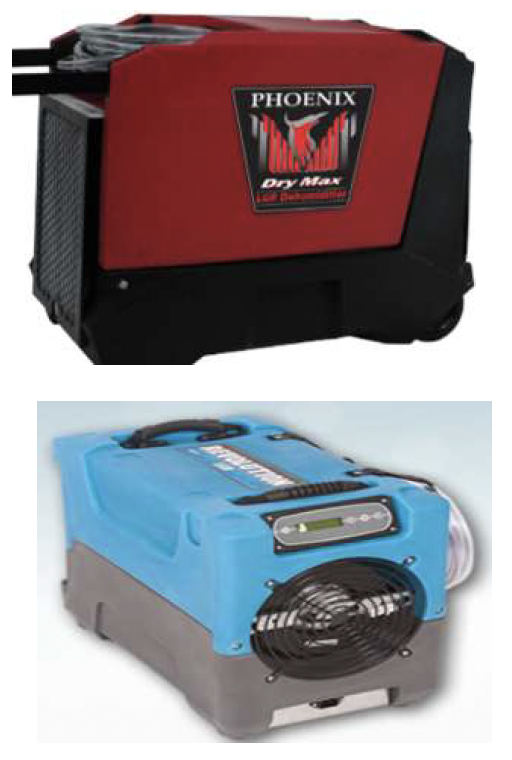
Today's LGR dehumidifiers have become smaller and more compact while not sacrificing efficiency. Make sure you have the latest drying technology to separate you from your competition and to show your expertise in drying.
Contractor Newsletter
Sign up today to receive quarterly tips on best practices in home repair, growing your contracting business, and more.